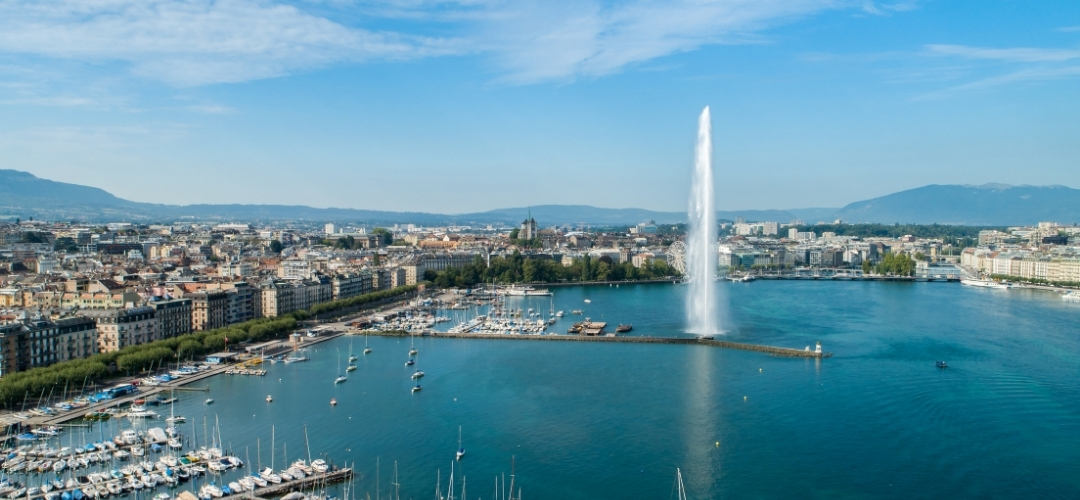
Geneva has long appealed to wealthy buyers seeking shelter in a turbulent world.
Its safe-haven status has become increasingly important as conflict in the Middle East and instability elsewhere have prompted some buyers to reconsider where they live.
The strength of the Swiss franc and low borrowing costs have helped, while Geneva’s broad choice of international schools makes it particularly attractive to families.
Switzerland’s neutrality provides security for its residents, said Alex Koch de Gooreynd, partner in Knight Frank’s international residential team. “They’re not on anyone’s hit list,” Koch de Gooreynd said. “If anything, they’re the ones who are negotiating with some of the warring factions around the world. You quite often see them all meeting in Geneva.”
The Geneva property market extends beyond the city itself to the surrounding canton, while some market measures cover the wider Lake Geneva region.
Luxury prices across that wider region rose 2.3% in 2025 and were around 15% above their 2020 level, according to a recent report by UBS, the Switzerland-based bank and financial services firm. In Geneva itself, average luxury values were around 28,000 francs (US$33,900) per square meter.
Tax and Lifestyle Add to the Draw
Geneva also has a tax advantage over some rival Swiss locations. Eligible foreign nationals who become residents without working there can qualify for a forfait fiscal, a program in which their tax bill is based largely on their living expenses rather than their worldwide income and assets.
For wealthy international buyers with substantial overseas income or assets, this can give Geneva an advantage over Zurich, which abolished the program in 2010, Koch de Gooreynd said.
However, unlike many other global luxury markets, Geneva is not a place where foreign buyers can simply purchase an investment property or holiday home. Switzerland’s Lex Koller rules restrict purchases by people living abroad, meaning most international buyers in Geneva need to become residents.
“The prime market remains a mix of Swiss buyers and international residents already established in Geneva,” said Baptiste Guyot-Sionnest, broker at SPG One, Christie’s International Real Estate.
Koch de Gooreynd said much of the overseas demand he sees comes from Europeans who once lived in the U.S., Middle East or Asia and are looking to return to Europe.
For those who choose to put down roots, Geneva’s range of schools means international families can choose between different education systems including American, British, French, Swiss and International Baccalaureate programs. This gives children who have started their education abroad the [ability] to continue in that curriculum if they wish.
The lifestyle is another selling point. Geneva is a well-connected international financial center, but set within a landscape that offers year-round outdoor pursuits, from water sports on the lake to cycling, hiking and skiing in the Alps.
Scarce Supply Supports Prices
Buyers are competing for relatively few homes. Geneva recorded 2,987 property transactions in 2025, and little changed from the previous year, according to the canton’s statistics office. Just 0.31% of its housing stock was vacant in June 2026.
“The shortage of quality stock remains one of the defining characteristics of Geneva’s market,” Baptiste Guyot-Sionnest said.
Family villas in prime areas are particularly difficult to find, while high-quality penthouses and waterfront properties are also scarce.
Many of the canton’s most expensive addresses are on Geneva’s Left Bank, which faces west toward the Jura Mountains and is removed from much of the airport, railway and highway noise affecting parts of the opposite shore.
Cologny, an elevated commune close to the city center, sits at the top of the market. UBS puts average luxury values there at around 42,000 francs per square meter.
“The lion’s share of the super-prime world, so above 10 million francs, is all in Cologny or Collonge-Bellerive,” he said.
Vandœuvres offers larger, flatter plots for those prepared to sacrifice a direct lake view, while Vésenaz and Vessy have also recorded strong growth, according to Colin Woolcock of Geneva Homes, an affiliate of Property Vision International.
Land itself accounts for much of the value in the most desirable areas, Koch de Gooreynd said. Homeowners will often extend or rebuild to maximize what can be constructed on their plot.
Prime land with clear lake views can command around 4,000 francs to 4,500 francs per square meter, Koch de Gooreynd said, with the best plots potentially reaching 5,000 francs.
A Seller’s Market With a Strong Outlook
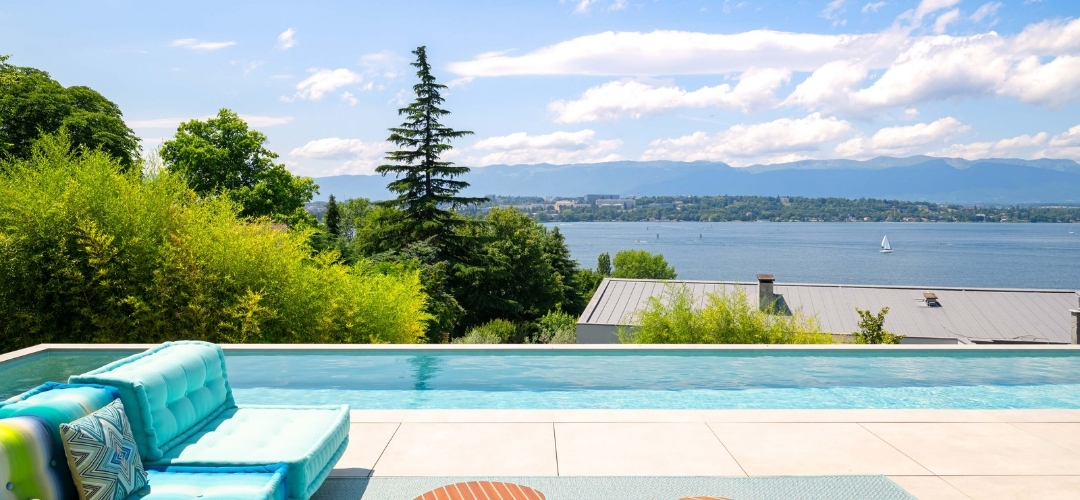
Buyers increasingly expect energy efficiency alongside high-end amenities, according to Baptiste Guyot-Sionnest. Swimming pools, wellness areas, home offices and sophisticated security systems are all frequently requested.
New urban developments offer a different type of luxury. At O’Belmont in Eaux-Vives, 23 high-end apartments designed by Ateliers Jean Nouvel include private outdoor space, concierge services, a spa and fitness facilities.
Woolcock described Geneva as a sellers’ market, with significantly more active buyers than available stock, and expects prices to remain strong for the next 12 to 18 months.
Koch de Gooreynd expects prices in the strongest prime areas to rise by around 2.5% to 3% a year if interest rates remain low and international uncertainty persists.
“I think we will see figures continuing to rise year on year,” he said. “I don’t think we’re going to see huge increases unless something dramatic changes.”
However, sellers must remain realistic, according to Byron Baciocchi, chairman and CEO of Unica Capital, a real estate investment company.
“Limited supply does not mean that every luxury home will sell quickly or at any asking price,” he said.“Disciplined pricing and a clearly differentiated property are particularly important in this environment.”
Discover the original article - Mansion Global
Article originally published in Mansion Global (mansionglobal.com) | By Leah Milner | Originally published on October 24, 2026

